Analysis · The ghost-demo study
Half of Steam demos are ghosts
We tracked roughly 2,100 demos from the day they went live this June — polling each one's live player count, over and over, the way you'd take a pulse.
Half of them never had one.
Not "a small audience." Not "a slow start." Zero — no concurrent players at any moment we looked, across the whole tracked window. The median demo peaked at one person playing at once. The top 1% peaked north of 700. A handful broke 9,000. Everyone else split the scraps.
This is the part of Steam nobody writes about, because the trade press covers the demos that already won. We watched the other 49%.
Followers are destiny
Here's the uncomfortable finding first, because it's the biggest one.
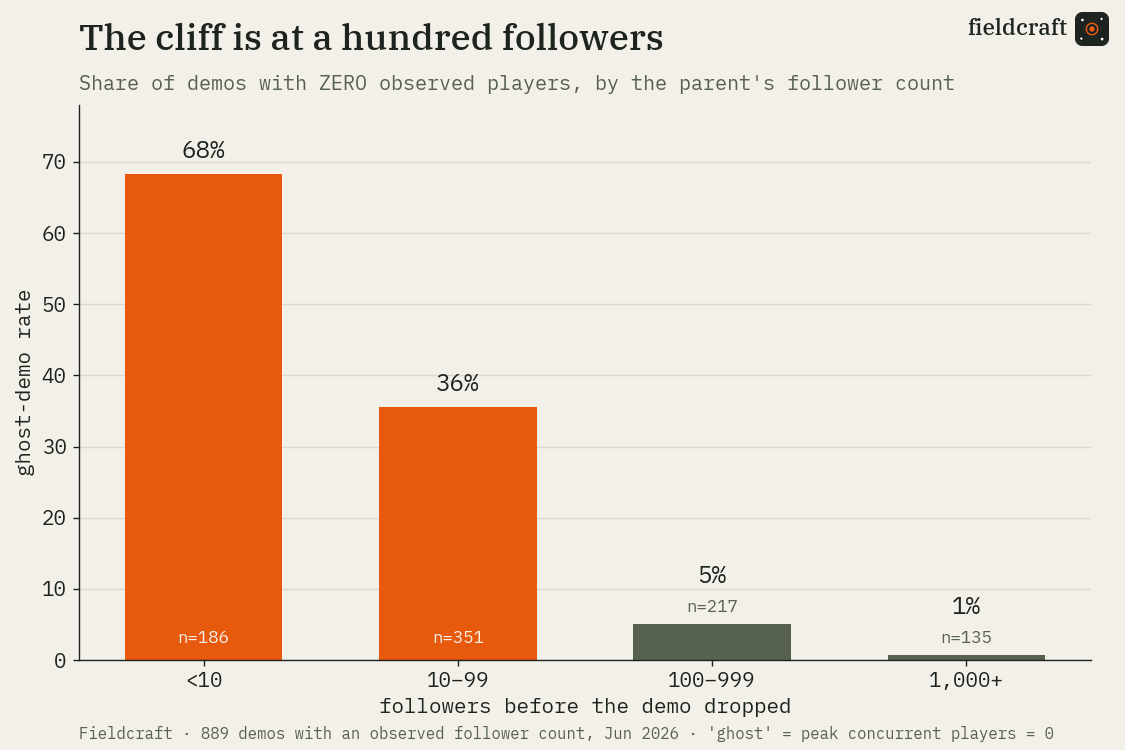
If the game already had a following before the demo dropped, the demo got played — full stop. A thousand-plus followers on the store page meant a zero percent ghost rate. Not one of them died unplayed. Drop below a hundred followers and you're a coin flip to be invisible.
In the regression, follower count swamped every other variable by a factor of three. The demo didn't earn its players in its first 48 hours. It inherited them — or it didn't. You mostly win or lose the discovery game before the demo ships.
That's the bad news. Now the part you can actually do something about.
The three avoidable mistakes
Strip out the games with a built-in audience and look only at the unknowns — the developers shipping into silence, no following, no safety net. Even there, the store page still moves the needle. Three things, specifically, each one independently predictive:
- shipping English-only
- five or fewer screenshots
- no trailer
Make none of these mistakes and you're at the cohort average. Make all three:
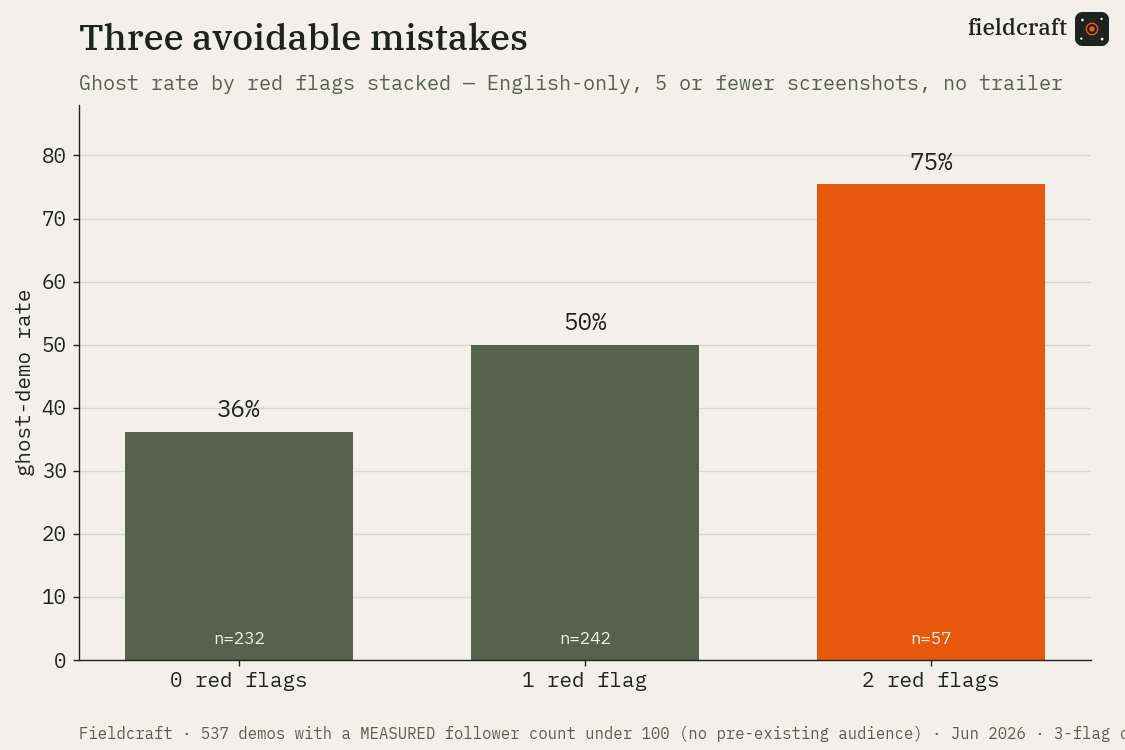
84%. Five in six demos, dead on arrival — and every one of those was avoidable in an afternoon. Localization, a few more screenshots, a thirty-second capture. None of it requires a marketing budget. It requires noticing.
Effort is just the checklist — and novelty is a myth
Two clarifications, because the easy version of this story gets both wrong.
Yes, effort matters — but it isn't magic, it's the checklist. Demos with a more polished store page were meaningfully less likely to be ghosts, and that holds up under scrutiny. But when we pull the "polish" apart, there's nothing left over: its entire effect is the trailer, the screenshots, the languages. There's no mysterious professional sheen that the algorithm rewards on top of doing those concrete things. Which is good news — "polish" isn't a vibe you have to be a studio to afford. It's a to-do list.
Novelty, though, is a myth. A weird, original tag combination correlated with getting played — but that's entirely who makes those games (serious teams, with followings), not the weirdness itself. Control for the audience and novelty's effect is exactly zero. Originality earns you a write-up. It does not, by itself, earn you a single player.
The fine print, because we'd rather you trust us
We measure "playing" by snapshot — we poll live player counts, we don't watch every second, so a demo someone played at 3am between our checks reads as a ghost. We think that's rare at zero, and it's measured the same way for everyone. Follower counts come from the public Steam group member list, which we can read for about seven in eight games. And most of this cohort dropped around June's Next Fest, where placement is its own invisible hand on the scale.
None of which changes the shape of the thing: a brutal power law, an audience you mostly build before the demo, and a short list of unforced errors that bury the games that didn't have to be buried.
We'll keep watching the half nobody else does.
— Fieldcraft
The instrument that produced this runs every morning.